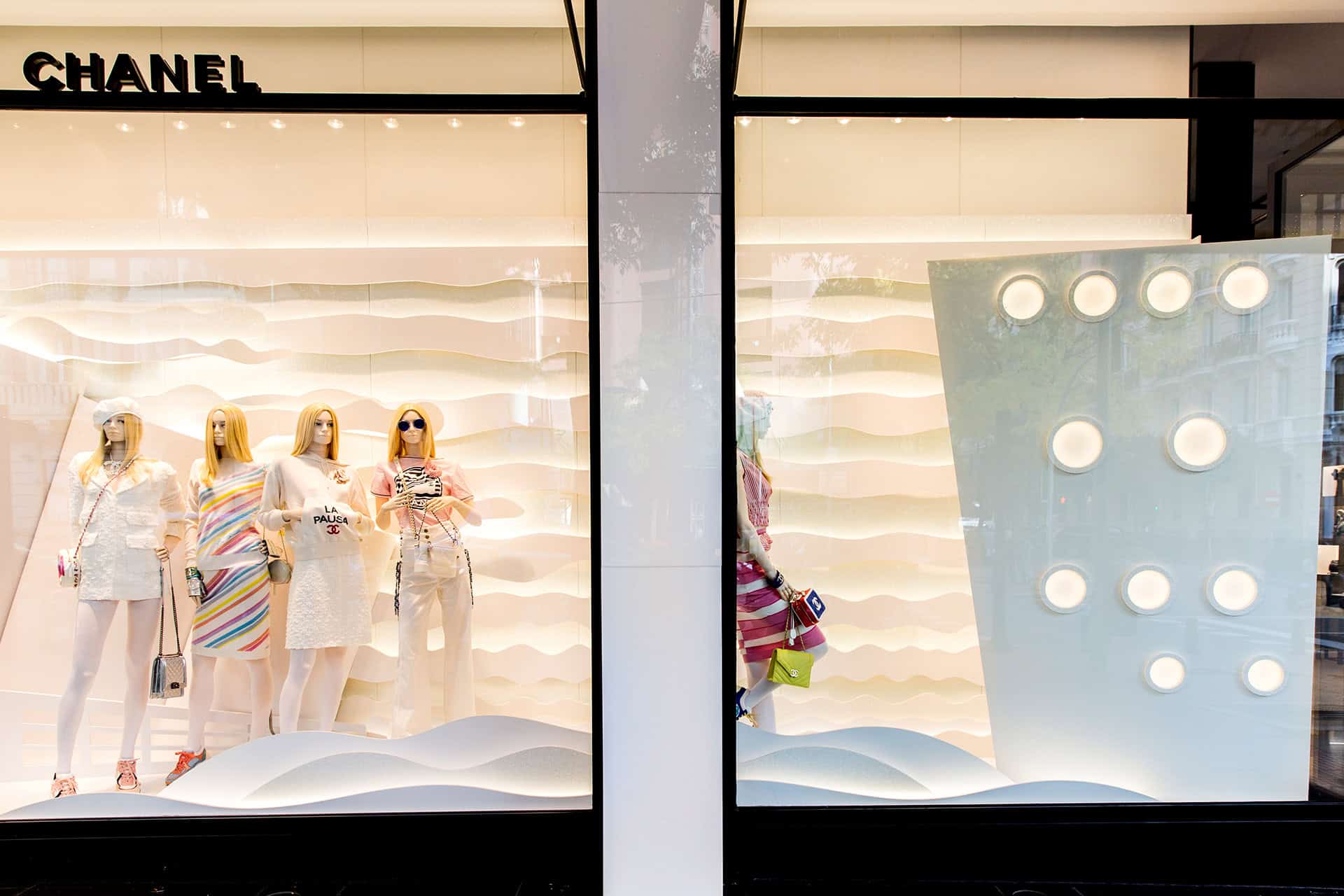

One morning in March 2023, pedestrians walking along Fifth Avenue in New York stopped in surprise in front of the Louis Vuitton store. In its window display, decorated with colorful flowers and polka dots, they could see artist Yayoi Kusama painting more dots onto the glass. As they got closer, they discovered it was a hyper-realistic robot of the 95-year-old Japanese artist, who not only continued decorating the space but also observed and greeted passersby. This activation has become one of the most viral recent campaigns by the French luxury house. The professional responsible for carrying out this implementation is the visual merchandiser, whose role is to design and organize retail spaces in an attractive and strategic way in order to capture customer attention and reinforce brand identity.
What Is the Job of Visual Merchandising?
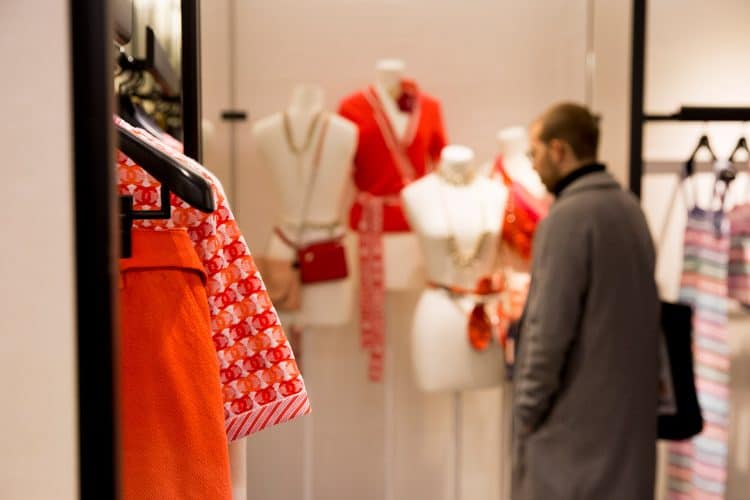
Visual merchandising is the technique of presenting products in an attractive way at points of sale. It uses color, lighting, furniture, and displays (store windows, points of sale, showcases…) to capture customer attention. Its objective is to enhance the shopping experience and reflect the brand’s identity. In addition, visual merchandising helps adapt stores to seasonal trends and marketing campaigns. Every brand—and therefore every store—is a different world.
Marketing, and specifically the specialty of visual merchandising, studies how customers behave in each space and how to design the environment to improve their shopping experience and ensure they leave with a positive memory. From store layout to window displays and digital experiences.
Eduardo Delgado, industry expert and Senior Store Manager, and instructor of the Vogue Online Course in Retail Design and Visual Merchandising for the Fashion and Luxury Sector at Vogue College of Fashion, shares his experience working for Saint Laurent:
“They don’t use mannequins, wanting the garment displayed in their windows to be the only visible piece. Their minimalism, combined with their exclusive store architecture—with cool materials and white lighting, as well as the duality of black and white marble with metallic touches in silver and gold—gives them the opportunity to showcase a recognizable and authentic identity, without the need for logos to highlight their way of understanding visual merchandising and product display.”
What Skills Are Necessary to Work in Visual Merchandising?
To work in visual merchandising, both technical and creative skills are required. Delgado mentions aesthetic sensibility to design attractive displays, adaptability to adjust the design to different spaces, analytical ability to understand the needs of each store and user profile, as well as knowledge of current trends.
“Even when there is a very defined internal store architecture image, spaces vary depending on the available display square footage, so flexibility to implement corporate guidelines across different points of sale is essential. Added to this is the analytical aspect, since a good visual merchandiser must understand the needs of each store and adapt the display accordingly, depending on the season, local events, and the actual stock available in each boutique.”
How Can You Train to Work in Visual Merchandising?
Training in visual merchandising is key to developing the necessary skills. According to Delgado, retail design and visual merchandising courses offer a comprehensive vision, combining theory and practice. These programs allow students to experience real-life situations, adapt to changing trends, and use new technologies in window display design.
“In my opinion, we aim to provide a solid theoretical foundation along with several practical case studies in order to gain a real 360° view of the needs within visual merchandising,” he explains.
Delgado is part of the faculty of the Vogue Online Course in Retail Design and Visual Merchandising for the Fashion and Luxury Sector. This program is delivered remotely, lasts three months, and is taught by some of the best professionals in the industry, including Delgado. The next edition begins on May 13. Spots are limited and now available.
What Is the Future of Visual Merchandising? How Has Digitalization Affected the Sector?
Visual merchandising is constantly evolving, influenced by technology and changing consumer preferences, especially after digitalization. As Delgado comments, “visual merchandising is essential in retail and will always be an important career.”
“First, because visual merchandising, being part of retail, behaves the same way. And since retail is constantly moving and adapting to consumer tastes, visual merchandising helps adapt those changes to new store architectures, as well as to the differentiation of trends and products, season after season. Second, retail cannot be understood without visual merchandising, so it will always be an important career to develop.”
The adaptation of physical stores to new trends and the personalization of the shopping experience will continue to be key in the future.
“From retail companies, we take every new technological implementation in our points of sale very seriously. To do so, we maintain a strict brand image that can be recognized in the two most visible elements for external customers of our boutiques, whether it’s the façade or the window displays. By doing it this way, the customer receives a series of corporate stimuli in our displays when they decide to enter the stores.”
He also notes: “Have you noticed that our online pages increasingly resemble our points of sale visually? I’m referring to colors, materials, and visual impact. It’s so that our brands are recognized by our online customers when they visit one of our physical stores.” Everything is carefully measured, especially in the luxury sector.
Frequently Asked Questions
1. What education is necessary to work in visual merchandising?
All branches of marketing and fashion are a good way to start in the profession. Specialized courses in visual merchandising, such as the Vogue Online Course in Retail Design and Visual Merchandising for the Fashion and Luxury Sector, provide the necessary tools to develop in this field.
2. Does a career in visual merchandising have a future?
Yes. According to experts, it is linked to retail and purchasing activity. As long as there is business—especially at a high level—there will be a need for a visual merchandising expert to shape it and present it to the world.
3. What is the relationship between visual merchandising and marketing?
Visual merchandising is a branch of marketing that seeks to adapt shopping spaces, whether digital or physical, to the brand’s identity, aiming to improve its image and the user experience.
Conclusion
Visual merchandising is a key discipline for the success of both physical and online stores. If you want to start your career, proper training in retail design and visual merchandising—such as the Vogue Online Course in Retail Design and Visual Merchandising for the Fashion and Luxury Sector—will provide you with the necessary foundation to adapt to constant market changes and create shopping experiences.
Ready to launch your career in visual merchandising?
The Vogue Online Course in Retail Design and Visual Merchandising for the Fashion and Luxury Sector is designed to give you the theoretical foundation and practical tools you need to shape retail spaces, strengthen brand identity, and create impactful shopping experiences.